This is the second year that I have been in India for Navratri, which means "nine nights". This important Hindu festival, which takes place twice a year, at the beginning of summer and the beginning of winter, honors the goddess, Durga, in all her nine forms. The name "Durga" means "the remover of the miseries of life" and Durga is considered the Divine Mother in the Hindu religion.
DURGA
The beginning of Navratri is determined by the lunar calendar. The nine days
are celebrated differently in various parts of India. The nine days are divided
into three sets of three to adore three different aspects of the Divine Mother.
In the first three days, Durga, also know as Kali, is revered as a
spiritual force, that destroys evil and grants boons. Kali is the "fearful and
ferocious form of the mother goddess."
KALI
In the second three days of Navaratri, another manifestation of Durga
is adored. As Lakshmi,she is the goddess of wealth and prosperity, both
physical and spiritual. In Hindu households, she is worshipped daily
"but October is her special month". Lakshmi, the wife of god Vishnu, is
the epitome of beauty. She is pictured sitting on a full blown lotus, with a
lotus bud in her hand, Gold coins fall from her four hands which represent
the four ends of human life - dharma or rightousness, "kama" or desires,
'artha" or wealth, and "moksha", liberation from the cycles of birth and death.
LAKSHMI
The last three days of Navratri are devoted to worship of the Divine Mother
as Saraswati, the goddess of wisdom and arts. She is worshipped for divine
knowledge and represents the free flow of wisdom and consciousness. Her
four hands represent the four aspects of human personality in learning: mind,
intellect, alertness and ego.
SARASWATI
For many Hindus, Navratri is a time of prayer and fasting. No meat, alcoholic
drinks, grains, wheat, garlic or onions are eaten in many households. Many
people have only milk and fruits during this nine day period.
Navratri is also considered an auspicious time for new undertakings and
ventures.
The nine day period is also celebrated in many parts of India, especially the
state of Gujurat with music and dance. Garba and Dandiya Raas originated
as dances in honor of Durga. The dance represents a battle between Durga
and Mahishasura, the demon king. Dancers whirl about and move their
arms and legs in a prescribed choreography to music, usually enhanced
by the dhol, a percussion instrument, as well as the dolak and tabla.
The sticks used in the dandiya represent the swords of Durga. Women
often dress in beautiful ghagra choli and dupattas, some wearing a
different color every day and they use their finest jewelry. Men have special
turbans and kedias.
The garba consists of hand and feet movement and is usually danced before
Aarti, a ritual of worship of the goddess, Durga. Garba can be danced by any
number of people.
Dandiya Raas is usually danced ater Aarti and it is a dance of merriment.
Most dandiya steps require two people and men and women dance in two
circles, one going clockwise, the other counter clockwise. To a four beat
rhythm, the dancers hit the sticks at the same time. Contrary to popular
belief, not all dandiya music is fast.
To see the dances, watch the YouTube videos below. The garba and raas
dandiya are now being danced internationally and there are world-wide
competitions to determine the best dancers.
My dream has always been to go to Baroda in Gujurat, duing Navratri. The
government sets up nightly festivities, some held at major venues where
dancing goes nonstop for several hours, with a whirl of colors, the clash of
A couple of evenings ago, my friend, Ajay Shekhawat, of the Umaid Mahal Hotel, took me out to see Jaipur's preparations for Diwali, celebrated by Indians in all parts of the world. Diwali, popularly known as "the festival of the lights", is a five day celebration, very important in the Hindu world. Families perform traditional celebrations in their homes and small lamps are lit to signify the triumph of good over evil. To learn more about Diwali, go to: http://en.wikipedia.org/wiki/Diwali or: http://www.diwalifestival.org/. Puja or offerings are made to the gods/ goddesses and gifts are exchanged among family or friends. As we rode through the street of downtown Jaipur and to one of the busiest bazaars, I was reminded of our own Christmas. Of course, it was a few days before Diwali and all the lights were not yet up. They don't start a month in advance as our retailers do in the U. S. It was noisy and crowded, though, at 8PM and I was told that in two days, vehicular traffic would be impossible and everyone would be on foot.
My night photography isn't the best but, at least, you'll get an idea.
We rode from Bani Park, where I live, into town, in an autorickshaw
Here the streets aren't so crowded but it all changes in a minute!
Jaipur is so much less crowded than Mumbai or Delhi
I'd like to go back and see what it looks like now, two days later!
Jaipur has some of the most beautiful architecture.
Ajay decides we should switch to a bicycle rickshaw so I can get
better shots
This is the brave soul who decides he can pull me!
Even though I've lost weight, Ajay has a tight squeeze fitting
next to me!
Most Indian business communities begin their financial
year on Dhanteras, the day the festival starts.
One's house is cleaned to make the goddess, Lakshmi, the
goddess of wealth, feel welcome
Now, it is very crowded in the streets and stores are busy.
This could be last minute Christmas shopping in the U. S.!
There are so many motorcycles parked, it's hard to get to the shops!
Rajasthan does have a helmet law - but the chin straps are rarely fastened nor do second ( or 3rd passenger ) seldom have one ) and children don't wear them!
This is the only cow I saw wandering in the downtown area. From the looks of him, he doesn't find much to eat.
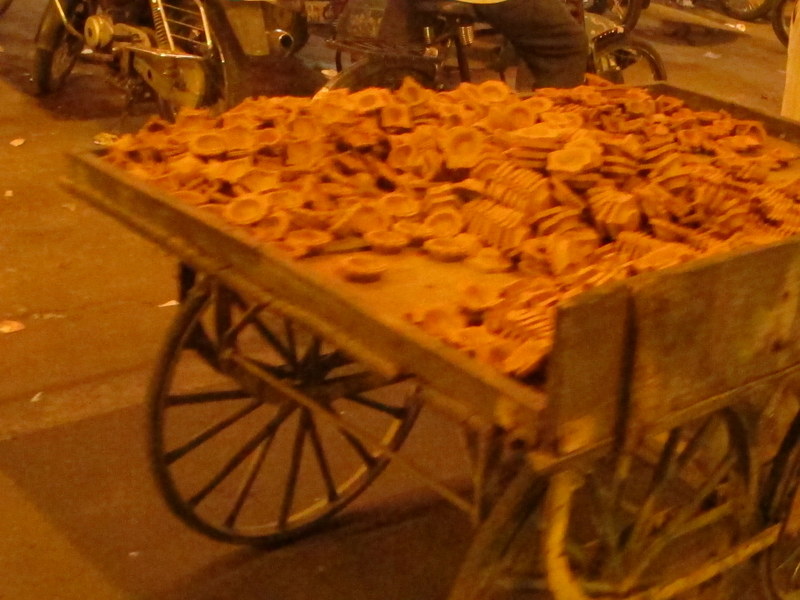
Ajay says oil and cotton are put in these little holders to
make Diwali lights....doesn't seem to safe around children!
People shop for new clothes for Diwali
I'm not sure if these guys were just waiting for their wives or what!